GRCop-42/C18150 in Rocket Thrust Chambers: Material Science and Engineering Perspective
1. What Problem Does GRCop-42 Solve?
The fundamental purpose of GRCop-42 is not simply to improve thermal conductivity, but to address a more critical limitation:
Maintain mechanical strength and microstructural stability at elevated temperatures (600–700°C and above).
This directly targets the primary weakness of conventional copper alloys such as C18150.
2. Limitation of Traditional CuCrZr (C18150)
C18150 relies on precipitation strengthening (Cr, Zr phases), which introduces several high-temperature limitations:
* Significant softening above ~500°C
* Coarsening of precipitates during thermal exposure
* Degradation under cyclic thermal loading (fatigue)
Implication:
* Acceptable for expendable engines。
* Limiting factor for reusable engines such as Raptor.
3. Core Innovation of GRCop-42
Transition in Strengthening Mechanism:
From precipitation strengthening → dispersion strengthening
4. Material Mechanism
Composition:
GRCop-42
* Cu–Cr–Nb system
* Formation of Cr₂Nb nanoscale precipitates
Strengthening Principle:
C18150 (CuCrZr):
* Precipitation strengthening
* Thermally unstable at high temperature
GRCop-42:
* Dispersion strengthening
Key characteristics:
* Nanoscale, stable Cr₂Nb particles
* Resistant to coarsening at high temperature
* Effective dislocation pinning
* Grain boundary stabilization
Result:
Stable mechanical properties maintained at 600–700°C
5. Engineering Property Comparison
Property | C18150 (CuCrZr) | GRCop-42 |
Thermal conductivity | ~320 W/m·K | ~300–340 W/m·K |
Room temperature strength | High | Moderate |
High-temperature strength | Degrades rapidly | Maintained |
Creep resistance | Moderate | Superior |
Thermal fatigue resistance | Moderate | Improved |
Microstructural stability | Limited | Excellent |
Key takeaway:
C18150 is optimized for conductivity;
GRCop-42 is optimized for high-temperature durability.
6. Relevance to Advanced Rocket Engines
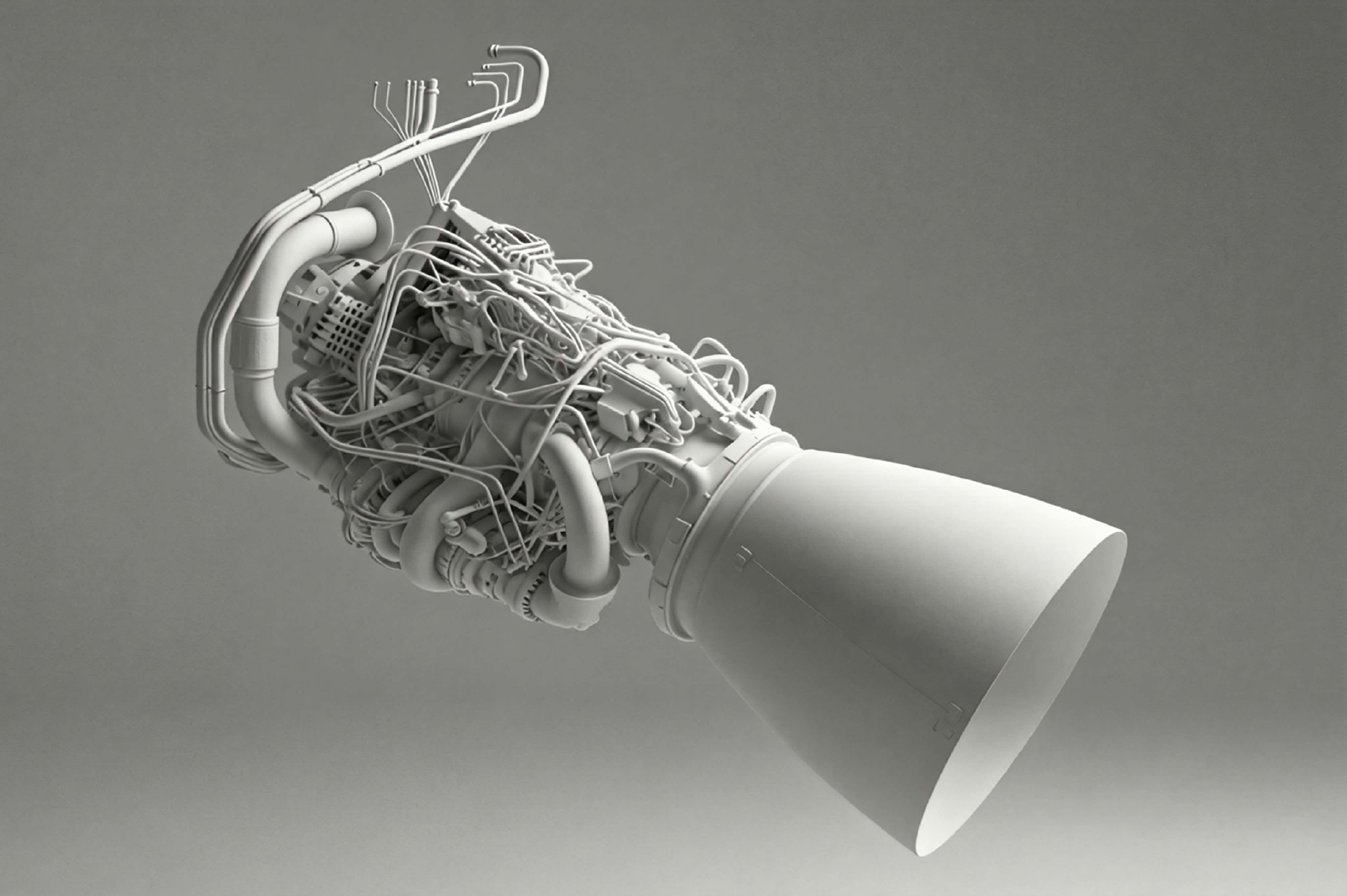
In high-performance engines such as Raptor:
* Chamber pressure: ~300 bar class
* Extremely high heat flux
* Complex regenerative cooling channels
Material requirements:
* Resistance to thermal softening
* Dimensional stability of cooling channels
* High cycle fatigue resistance
GRCop-42 directly addresses these constraints.
7. Manufacturing Compatibility (Critical Advantage)
Designed for Additive Manufacturing.
GRCop-42 is inherently compatible with:
* Laser Powder Bed Fusion (LPBF / SLM)
* Powder metallurgy processing routes
Typical Manufacturing Workflow:
1. Powder production (gas atomization)
2. Additive manufacturing (LPBF)
3. Hot Isostatic Pressing (HIP)
4. Minimal post-processing
Compared to C18150:
Aspect | C18150 | GRCop-42 |
Manufacturing route | Machining + brazing | Additive manufacturing |
Heat treatment dependence | High | Lower |
Design flexibility | Limited | Very high |
Structural interfaces | Multiple joints | Reduced interfaces |
8. Design Impact (Most Important Insight)
The main advantage of GRCop-42 is not incremental performance gain, but a significant expansion of design freedom.
With traditional materials:
* Geometry must adapt to manufacturing constraints
With GRCop-42 + AM:
* Manufacturing adapts to thermal design
Enables:
* Complex cooling channel geometries
* Localized heat flux optimization
* Non-uniform wall structures
* Integrated components
9. Reusability Implications
For reusable launch systems:
* High cycle thermal loading
* Repeated start-stop operations
* Long service life requirements
GRCop-42 provides:
* Improved thermal fatigue resistance
* Enhanced creep resistance
* Stable microstructure over repeated cycles
10. Final Summary
Fundamental Difference:
* C18150 → precipitation-strengthened copper alloy
* GRCop-42 → dispersion-strengthened copper alloy
Engineering Philosophy:
* Traditional alloys → Material constrains design
* GRCop-42 → Manufacturing enables design freedom
Strategic Importance:
GRCop-42 is a key enabling material for high-performance, reusable rocket engines, particularly when combined with additive manufacturing technologies.